
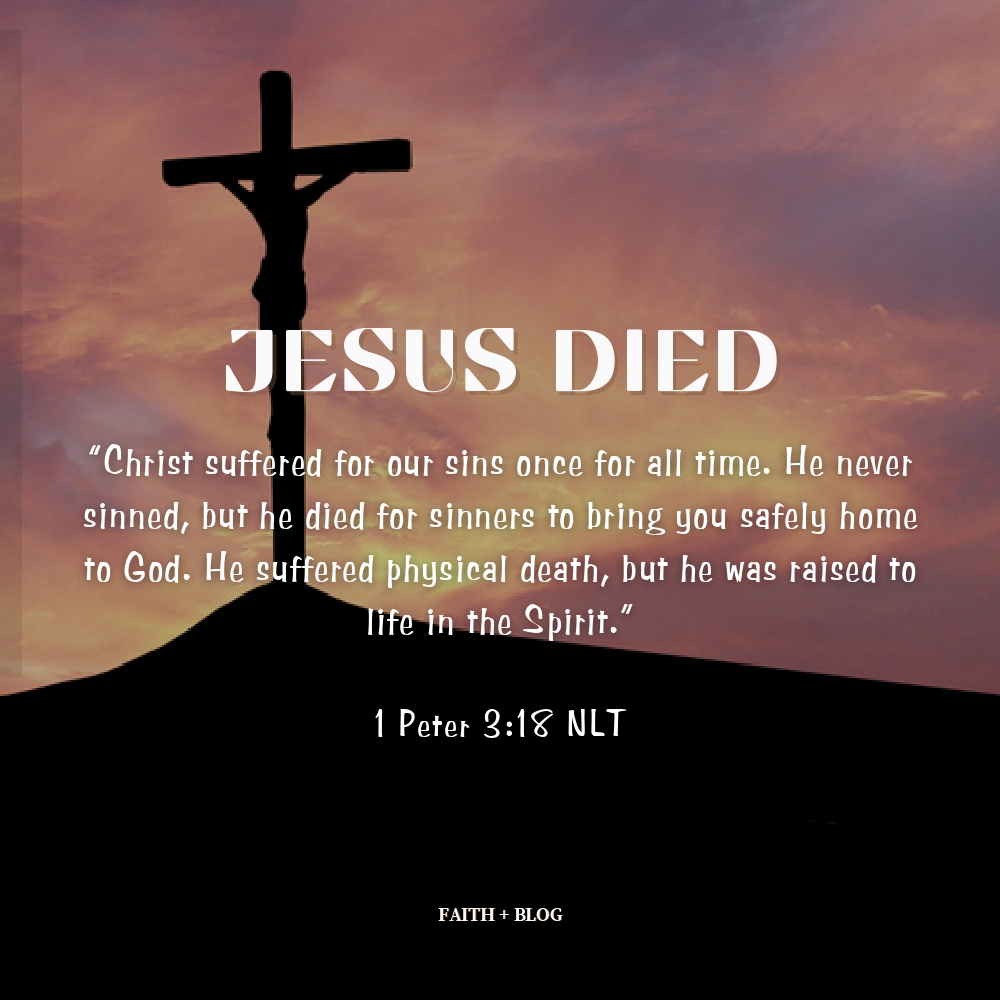
It should not surprise us that Jesus died. And might I add, for our sins. His death was not the ordinary end that eventually comes to every living thing. It was a pre-planned, perfectly executed, self-willing sacrifice paid for the atonement of our sins. (Rev. 13:8)
For some people, this is a fact so mind-boggling that they have refused to accept it. But since when did God’s mysterious display equal “impossible”?
Why did Jesus die?
Simply put, Jesus died because of our sins. Since the fall of man, it became terribly difficult for humanity to fully resist and overcome sin. It became second nature to mankind. The issue with this is that sin has a repercussion. Scripture tells us that this is death (Eze. 18:20, Rom. 6:23).
So ideally, we all had a death sentence hanging over our heads because of how impossible it was not to sin. God then provided a temporary solution—the sacrifice of animals. This did not wipe away sin but at least it covered it. Still, it was merely a shadow that pointed to the real sacrifice that was to come, and with today’s population, this method would surely have become a problem. (Heb. 10:4)
We would always keep falling short and the need to balance the equation between sin and sacrifice would always remain. So God gives the final, lasting and true solution. He looked upon us with His tender mercies and loving kindness, and gave us Himself. Jesus hung on the cross, bearing the weight of sins He didn’t commit, paying a debt He didn’t owe, still He prayed for our forgiveness. And through His death, forgiveness became possible for all who believe.
However, the dividends of His death don’t stop there. The Book of John tells us that God became flesh and eventually died in our place, that we may be delivered from sin. Sin tormented us with the surety of its penalty, but when Jesus died, He saved us from its power. On that cross, He nailed our former selves that were unable to say no to sin. Now, through faith in Him, we have become new creatures who have received grace to reject ungodliness. (2 Cor. 5:17, Tit. 2:11-12).
Moreover, sin had wedged between us and God, a distance so great that it required the power of God Himself to remove. By Jesus’ death, He reconciled us with God, dealing with the very thing that caused the separation and access to the Father. (Col. 1:21-22)
“In the beginning was the Word, and the Word was with God, and the Word was God.
The Word became flesh and made his dwelling among us. We have seen his glory, the glory of the one and only Son, who came from the Father, full of grace and truth.
No one has ever seen God, but the one and only Son, who is himself God and[b] is in closest relationship with the Father, has made him known.
The next day John saw Jesus coming toward him and said, “Look, the Lamb of God, who takes away the sin of the world!”
(John 1:1, 14, 17,29 NIV)
God pronounced death as judgment against Adam and Eve when they sinned. Since then, the fear of death has become a thing. Death was always going to be there, only that we would not fear it and it wouldn’t have been as merciless as it is now. But since the big mess up, we have had to deal with the fear of death. But, by dying, Jesus conquered death and its fear. Believers don’t see it as the scary monster it once was. Rather, to us, it is merely sleep (1 Thess. 4:13-14).
14 Since therefore the children share in flesh and blood, he himself likewise partook of the same things, that through death he might destroy the one who has the power of death, that is, the devil, 15 and deliver all those who through fear of death were subject to lifelong slavery.
Hebrews 2:14-15 ESV
Eventually, His death became the foundation of our salvation (Jn 3:16). All who trusted in the name of the Lord and all who would come to trust could now gain access to a gift that was privy to only a certain people. Faith in the sacrifice of Jesus leveled us all; the ones who have eternal life. Or simply put, the saved.
Why Jesus?
“Okay, I get the reason why He died and what it achieved, but why did it have to be Him?”
No one else could have done it. No one else was blameless enough to take the fall for others. No one else could have been humble enough to stoop as low as He did. No one else could have made the perfect sacrifice other than the Lamb of God Himself. (1 Pet. 1:18-19)
For every sacrifice, it was important that the lamb or animal presented was pure and without blemish. Only God is without sin. Only He is truly pure. That is why He came in flesh to carry out the atonement by Himself. By identifying with Jesus, we identify with that sacrifice.
What if Jesus didn’t die?
Like I mentioned earlier, some people believe that He didn’t die and they have their argument, albeit false. While I won’t go into debunking each argument, I would like to flip the story and see where it leads.
What if, as these people falsely claim, Jesus did not die?
The first and obvious answer is that there would be no forgiveness of sin. If Jesus never died, yet we have abandoned the one system for forgiveness that God created, then aren’t we in trouble? That would mean we have been living life carelessly, not caring about His forgiveness. The only thing that awaits such disregard is damnation. Yikes!
Furthermore, there would be no salvation. Salvation came because Jesus died. Eternal life became a reality because Jesus died. Hope was reawakened because Jesus died. As sad as the event of an innocent Man dying a terrible death is, it is still the most joyful thing ever to happen to mankind; the penalty for our wrongdoing was taken care of and we were given hope that transcends this present life.
The third and probably most pivotal thing is that it would mean scripture—all of it—is a lie. From Genesis to Revelation, we see predictions and prophecies regarding Jesus, His death, resurrection and reign. Scripture either speaks anticipating His death or referencing His death. If it never happened, then what we have in hand is a fallacious book, cover to cover.
The Unavoidable Conclusion
Then again, how likely could it be that about 40 different authors, across 2000 years—many of whom didn’t live in the same lifetime—wrote the same gospel and point towards the same person and event? And through the lives of some others we get a foreshadowing of what is to come and they all attest to the same thing? It then makes one wonder, perhaps it’s all true.
Perhaps God really loves us so much that He didn’t want us fated for damnation. Perhaps He cares so much that He took the responsibility of our well-being—both physical and spiritual—upon Himself.
He made the One who did not know sin to be sin for us, so that we might become the righteousness of God in Him
2 Corinthians 5:21
Jesus really did die and that was not just for our benefit, but in our place. It was a debt we could never pay and He so willingly paid it for us, in advance too! The punishment that belonged to us fell upon Him and by His death, He fulfilled scripture, paid the price of sin and still conquered it, ultimately displaying His love for us and granting us salvation. (Isa. 53:5)
Jesus died—and that changes everything for everyone who believes.

 Faith+blog