
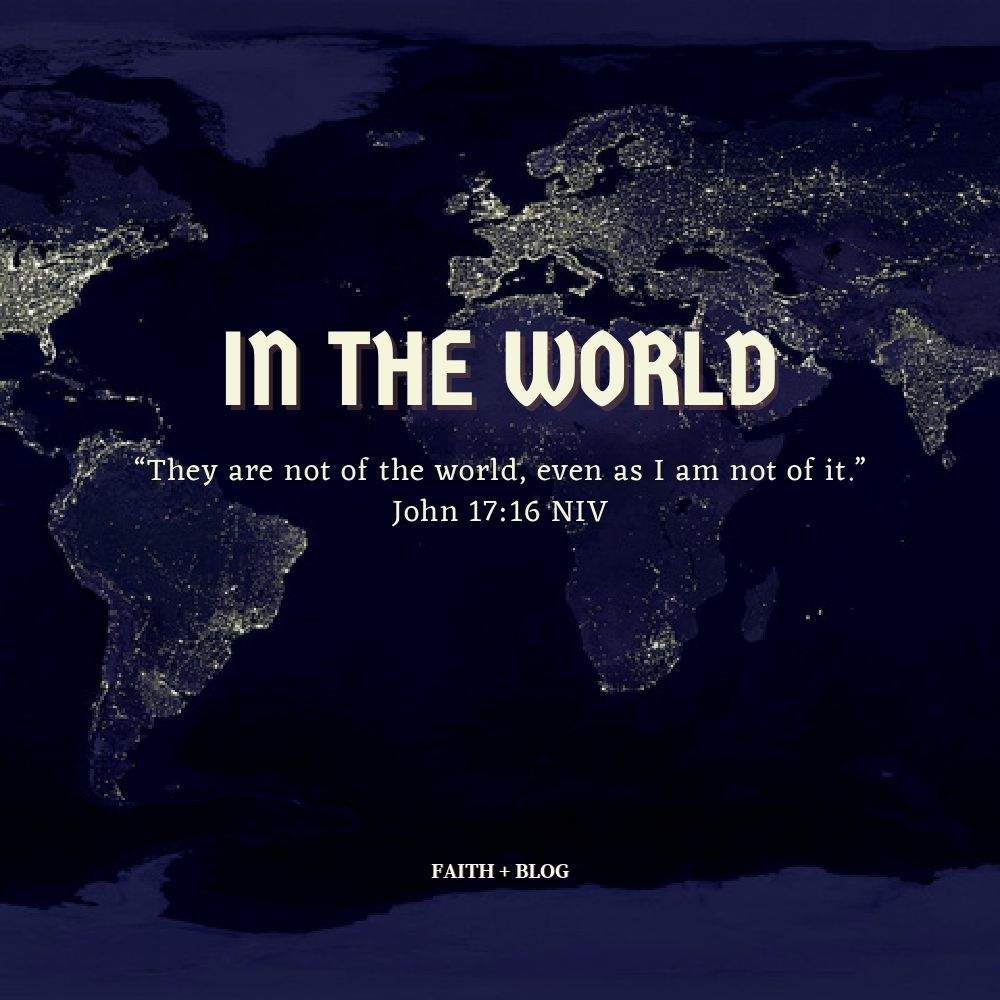
We live in the world; we do not belong to it. Jesus Himself made this distinction clear, saying that His followers are “not of the world, even as I am not of it” (Jhn. 17:16). In other words, those who believe in Christ are no longer defined by the mindset, values, and patterns of the world. Through faith in Him, they receive a new identity and are called to live differently from those who do not know Him.
This new identity creates a clear contrast. Scripture describes believers as people who have moved “from darkness to light” (1 Pet. 2:9). The transformation reflects the character of Christ rather than the values of the world around us.
Some people, however, have misunderstood the idea of being “not of the world.” In trying to obey it, they withdraw entirely from society. They avoid friendships, meaningful relationships, and culture, and some even go so far as to avoid secular jobs. But this was never Christ’s intention. After all, the world itself was created by God. Jesus was not praying that we would be removed from the world—as a place, but that we would be protected from the world—as a vice (Jhn. 17:15). If light chooses to remain only where there is already light, it loses its purpose. Light was made to shine in darkness. If Jesus has called us light, then our purpose is to shine in this dark world. (Matt. 5:14–16).
Likewise, in the effort to “reach the world,” some believers have gone to the opposite extreme and brought dishonor to the name of Christ. In an attempt to appear relevant, believers are reshaping scripture to suit popular taste, worship is becoming a performance, prayer becomes social media content, and the church is becoming little more than a social gathering. While the desire to draw people to God may be sincere, the method is totally misguided. The power of the gospel does not depend on human theatrics or trends. It has enough power on its own to save (Rom. 1:16).
The early church understood this well. When Peter preached on the day of Pentecost, it was not theatrics that brought conviction, but the message of Christ preached as plain and as simple as it is. This led to about three thousand people being converted (Acts 2:41). The apostle Paul intentionally avoided relying on impressive speech or human wisdom so that faith would rest on the power of God (1 Cor. 2:1–5). The gospel itself is sufficient; it does not require embellishment.
Believers are therefore not called to lower the standards given in the Word of God in order to blend in with the world. Rather, we are called to influence it. Jesus compared the kingdom of God to yeast working through dough (Matt. 13:33), and that is how we must be, stable and influencing our environment. We are called to live within society while allowing the character of Christ to shape and transform not just us, but also the world.
Our lives are meant to reflect something different. Yet when believers imitate the culture around them, the distinction becomes blurred. Instead of the church shaping the world, the world begins shaping the church. But God has always called His people to live distinctly. When He delivered Israel from Egypt, He commanded them not to adopt the practices of the surrounding nations (Lev. 18:3). The same principle applies to believers today. Romans 12:2 says
“Do not conform to the pattern of this world, but be transformed by the renewing of your mind.”
This leads to one of the clearest marks of a true follower of Christ—love. Jesus said, “By this everyone will know that you are my disciples, if you love one another” (Jhn. 13:35). Love is foundational to the Christian life. Without it, there is nothing that distinguishes believers from the world. Scripture goes even further to say that “whoever does not love does not know God, because God is love” (Jhn. 4:8).
The world often encourages us to love only those who love us in return. But Jesus raised the standard far higher, commanding His followers to love even their enemies (Matt. 5:44). Through this kind of love, the world catches a glimpse of God’s own heart. Through this kind of love, we fulfill the commandments, including the instruction to preach the gospel—because the gospel itself is love.
Truthfully, it can be easy to blend in when living in a world saturated with corruption. Even though the children of Israel lived apart from the Egyptians and other pagan nations of their time, scripture helps us understand that they were unable to overcome the influence.
So as a “safety net”, Scripture gives clear instructions such as “Do not be yoked together with unbelievers” (2 Cor. 6:14). Moreover, it is not something we accomplish by human effort alone. God has given us His Spirit as our helper. Jesus promised that the Holy Spirit would teach and guide believers into truth (Jhn. 14:26). Through His guidance, we can live as God’s representatives in the world, reflecting His character while remaining uncorrupted by the values around us.
At the same time, believers are commanded to “go into all the world and preach the gospel” (Mk. 16:15). The more people we can reach with the truth, the less the influence of the world on believers. We are to guard our hearts from being shaped by the world, while still reaching out to those within it. After all, light finds purpose in darkness.
Being “in the world but not of it” is therefore not a call to isolation, nor is it permission for imitation. It is a call to faithful distinction. We are placed in the world intentionally, to shine as light, to preserve as salt, and to reflect the character of Christ in a world that desperately needs Him. As Scripture reminds us, “you are the light of the world… let your light shine before others”(Matt. 5:14–16).

 Faith+blog